
Intumescent Fire Protection
Intumescent fire protection for structural steel in Accra and Tema — char-forming coatings that deliver documented 30, 60, 90, and 120-minute fire-resistance ratings to BS 476-20/-21 and EN 13501-2. Coralex Painters, since 1972.
Intumescent fire protection is a char-forming coating for structural steel that stays a thin film in normal service, then under fire expands around 50 times its thickness into an insulating foam that holds the steel below its critical temperature. Coralex Painters has delivered specification-grade protective coating work across Accra, Tema, and Kumasi since 1972, treating fire protection as a life-safety discipline rather than a finish.
Why Intumescent Fire Protection Matters in Ghana’s Conditions
Unprotected structural steel loses load-bearing capacity rapidly in a fire — as the section approaches its critical temperature, strength falls away and the frame it carries moves toward collapse, often long before a building can be safely evacuated. Intumescent protection exists to buy that rated time, and on institutional and commercial frames in Accra and Tema it is the difference between a compliant fire strategy and an unprotected one.
Ghana adds a practical test. Thin-film intumescents are moisture-sensitive during cure, and in a climate where relative humidity averages around 81% the application window and curing conditions have to be controlled, not assumed. We specify the system to the steel, the required rating, and the exposure — interior thin-film where it suits, epoxy thick-film where the environment is harsher.
Intumescent Systems We Offer in Accra
Thin-Film Intumescent Coatings
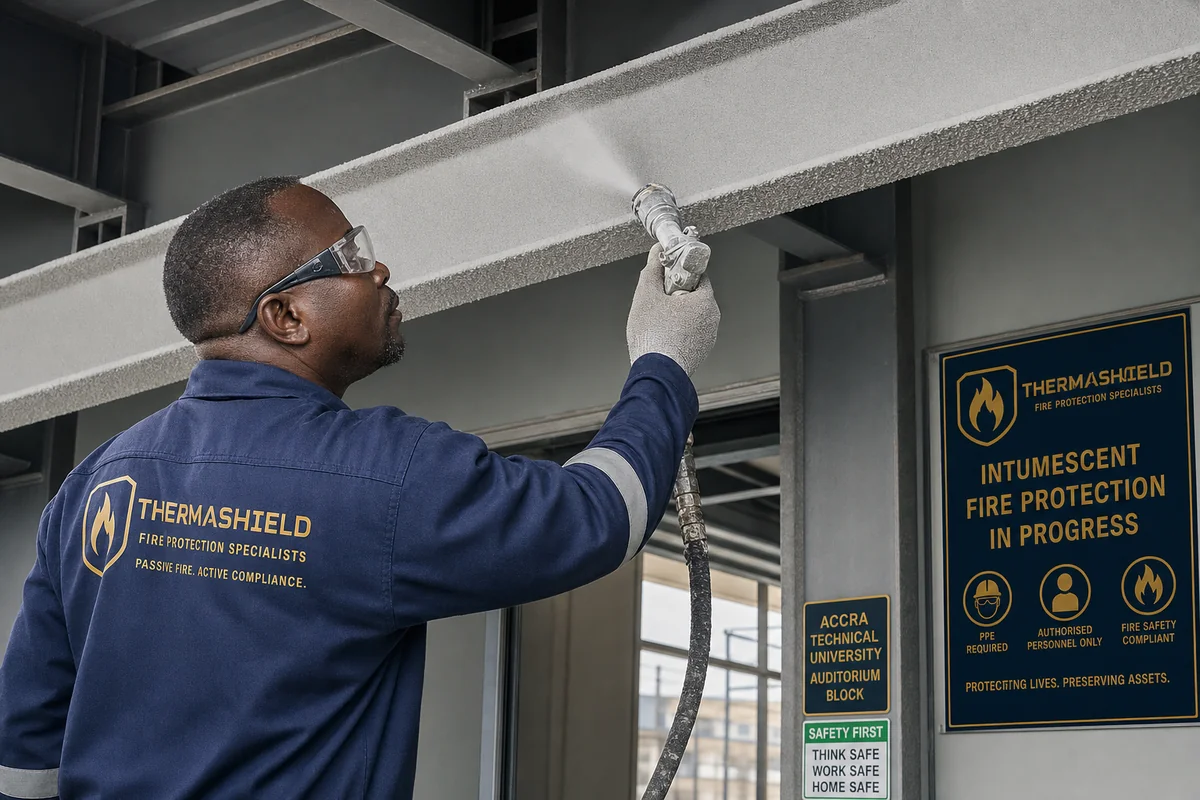
Water-based and solvent-based thin-film intumescents are the workhorse for interior structural steel — columns, beams, and exposed frames in offices, institutions, and commercial buildings. They remain an unobtrusive thin film in service and deliver rated protection when loaded correctly. Because they are moisture-sensitive, we control conditions through application and cure.
Epoxy Thick-Film Systems
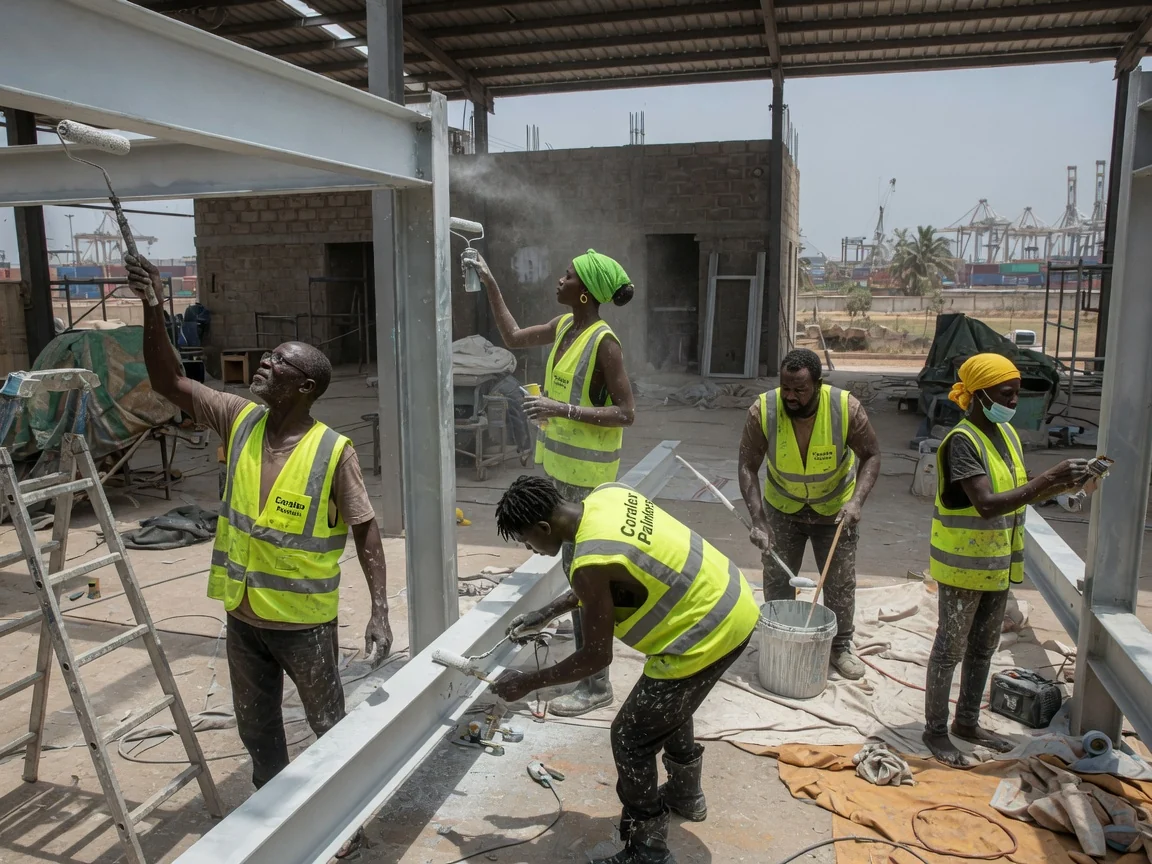
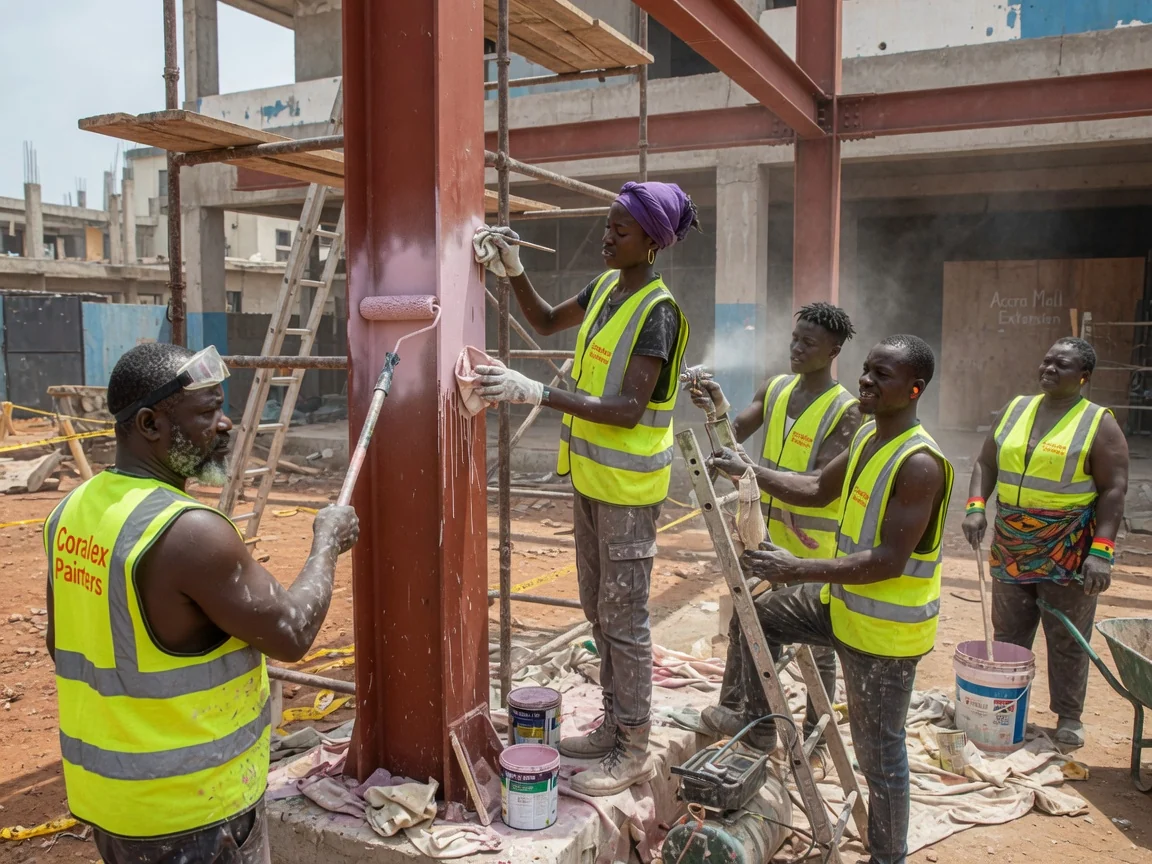
Epoxy intumescent thick-film systems are specified for harsher and external exposures where a thin-film coating would not hold up — heavier structural members and steelwork carrying critical loads in industrial and port-adjacent environments.
Sealers & Decorative Topcoats
Where the system requires it, a compatible sealer or decorative topcoat protects the intumescent film in service and gives the exposed steel its finished appearance — applied only after the dry-film thickness gate is passed.
Applications Across Ghana
- Load-bearing steel frames, columns, and beams in institutional and commercial buildings across East Legon, Airport City, and Ridge
- Exposed structural steelwork on escape routes where a rated fire-resistance period is set by the fire strategy
- Steel transfer structures and primary frame members carrying critical loads in Tema and Spintex
- Architecturally exposed steel where a thin-film intumescent finish is specified over board encasement
How We Apply Intumescent Protection
- Steel schedule & rating review — the required 30/60/90/120-minute period is read from the fire strategy for each member.
- Surface preparation & priming — steel cleaned and graded to ISO 8501 with a compatible primer applied.
- Loaded application — the intumescent base coat is built to the thickness the system requires for the rated period.
- Verification & sealing — dry-film thickness checked to ISO 2808 as a life-safety gate before any sealer or topcoat closes the work.
Comparing Intumescent Systems
| System | Char mechanism | Best for | Exposure |
|---|---|---|---|
| Thin-film, water-based | Expands ~50× above ~200-250°C into insulating char | Interior structural steel, escape routes | Conditioned interior; moisture-sensitive |
| Thin-film, solvent-based | Same char chemistry, faster cure tolerance | Interior steel where humidity is harder to control | Interior; moisture-sensitive |
| Epoxy thick-film | High-build char system | Heavy and external steelwork, harsh exposure | External / industrial / port-adjacent |
What Affects the Cost in Accra
- The steel sections protected and their section factor (lighter, more exposed members need more coating)
- The required fire-resistance rating — 30, 60, 90, or 120 minutes
- Whether a thin-film or epoxy thick-film system is specified for the exposure
- Surface preparation and primer required to grade the steel to ISO 8501
- Whether a sealer or decorative topcoat is needed for the service environment
Every quote follows a survey of the steel schedule and the fire strategy — no fixed price is given before the steel is reviewed.
Areas We Serve
Coralex Painters delivers intumescent fire protection across Greater Accra — East Legon, Airport Residential, Cantonments, Labone, Roman Ridge, Dzorwulu, Trasacco, Spintex, Osu, and Tema — plus Kumasi and Takoradi.
Related Services
- Industrial Coatings — ISO 12944 protective systems for steel, plant, and pipework
- Institutional Painting — durable, compliant finishes for institutional buildings
- Waterproofing & Protective Coatings — roof, terrace, and structural protection systems
Frequently Asked Questions
How does intumescent paint actually protect steel in a fire? In normal service it is a thin decorative film. Above roughly 200-250°C the binder chemistry — typically an ammonium polyphosphate acid source, a pentaerythritol carbon source, and a melamine blowing agent — reacts and expands the coating around 50 times its original thickness into an insulating char foam. That char slows heat reaching the steel, holding the section below its critical temperature for the rated 30, 60, 90, or 120 minutes.
What fire-resistance ratings can you achieve, and to what standard? We work to 30, 60, 90, and 120-minute ratings, with performance aligned to BS 476 Part 20 and Part 21 and EN 13501-2 fire-resistance classification. The required period is set by the building fire strategy for each structural element, and the coating is loaded to achieve exactly that period.
Thin-film or thick-film — which intumescent system do you use? It depends on exposure. Thin-film water-based or solvent-based intumescents suit interior structural steel in offices, institutions, and commercial buildings. Epoxy thick-film systems are specified for harsher or external exposure. Thin-film systems are moisture-sensitive, so we control conditions during cure and seal where the environment requires it.
How much does intumescent fire protection cost in Accra? It is quoted only after a survey, because loading depends on the steel sections, the required rating, and the system selected — there is no fixed per-square-metre price. We never quote intumescent work before reviewing the steel schedule and the fire strategy on survey.