
Waterproofing & Protective Coatings
Waterproofing in Accra, Ghana — cementitious, liquid-applied PU/acrylic, and bituminous membrane systems for roofs, terraces, water tanks, and below-grade walls, with the fixes for peeling paint, rising damp, mould, salt patches, and leaking roofs. Coralex Painters, since 1972.
Waterproofing is a barrier system — cementitious, liquid-applied, or bituminous — that keeps water out of a building’s roofs, terraces, tanks, and below-grade walls. Coralex Painters has waterproofed and protected structures across Accra, Tema, and Kumasi since 1972, treating the membrane and the substrate beneath it as a single engineered responsibility.
Why Waterproofing Matters in Ghana’s Conditions
Water is the single most destructive agent acting on a building, and in Ghana’s climate it acts relentlessly. Accra receives roughly 730 mm of rain a year, concentrated in two wet seasons that pond on flat roofs, drive at parapets, and load below-grade walls from outside. When water reaches an unprotected substrate, the damage cascades: reinforcement corrodes and spalls the concrete around it, finishes blister and delaminate, and a defect that began as a hairline crack ends as structural expense many times the cost of the original membrane.
A membrane is not a finish that can be touched up later — it is a buried, concealed, or trafficked barrier that must be engineered correctly the first time. We specify the system to the exposure, prepare and verify the substrate, build the membrane to a measured thickness, and prove its integrity by flood test before any overlay or backfill closes it from view.
Waterproofing Systems We Offer in Accra
Cementitious (Polymer-Modified) Waterproofing
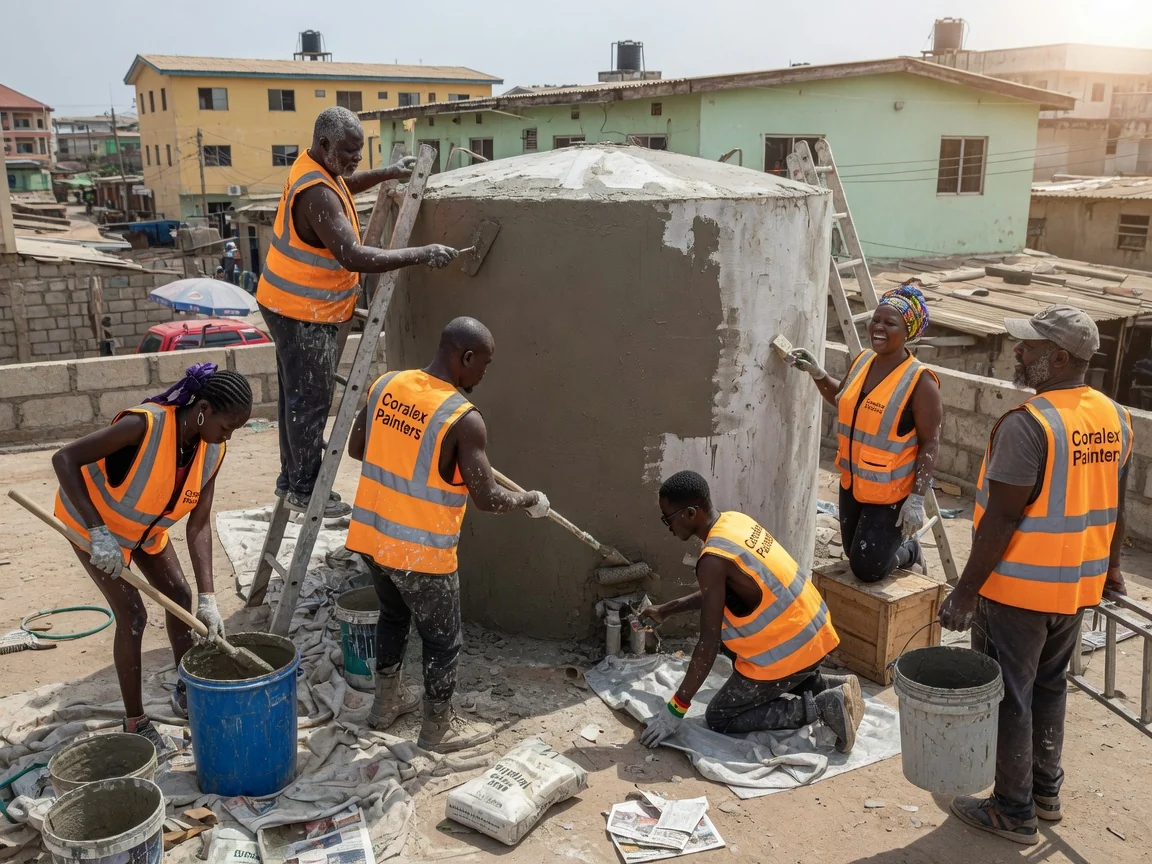
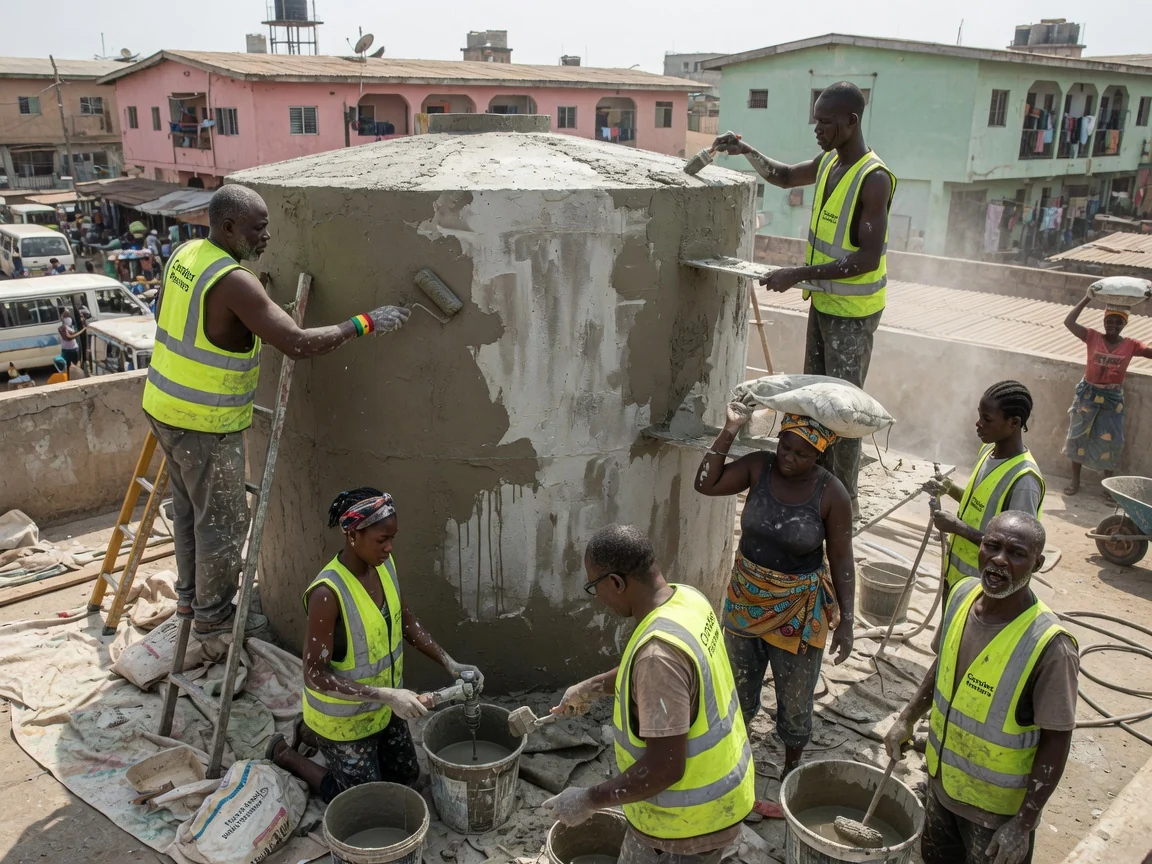
A rigid, breathable slurry of cement and polymer, brushed or trowelled onto sound concrete. Because it breathes, it suits water tanks, swimming pools, basements, and wet areas — bathrooms, plant rooms, and kitchens — where the structure must hold water on one side without trapping vapour on the other. Potable-rated grades are specified where the tank stores drinking water.
Liquid-Applied (PU / Acrylic / Crystalline)
Liquid-applied membranes cure to a seamless, crack-bridging film with no joints to fail. Polyurethane (PU) and acrylic systems are specified for terraces, flat and low-slope roofs, and podium decks; an ASTM C836 cold liquid-applied elastomeric membrane is a buried, crack-bridging layer that needs a separate wearing course over it rather than being left exposed to traffic. Crystalline systems are used where the waterproofing must work integrally with the concrete.
Bituminous & Below-Grade Membranes
Bituminous systems give heavy crack-bridging for foundations, retaining walls, lift pits, and other below-grade structures loaded by groundwater, where movement and hydrostatic head demand a tough, flexible barrier behind the structure.
Applications Across Ghana
- Flat and low-slope roof decks that pond under heavy rainfall across Accra and Tema
- Exposed and trafficked terraces, balconies, and podium slabs over occupied space
- Water tanks, reservoirs, and swimming pools, including potable-rated linings
- Wet areas — bathrooms, plant rooms, and kitchens — needing tanked floors and upstands
- Basements, lift pits, and retaining walls loaded by groundwater
How We Waterproof a Flat Concrete Roof
- Survey & moisture test — falls, drainage, cracks, and ponding assessed; the slab is moisture-tested before any membrane goes down.
- Substrate preparation — deck graded to ISO 8501; laitance and loose coatings removed, cracks stabilised, outlets made sound.
- Detailing & reinforcement — drains, upstands, parapets, and movement joints reinforced first, because that is where roofs leak.
- Membrane build & DFT check — liquid-applied membrane built to the specified dry film thickness, verified to ISO 2808.
- Flood test & handover — flood-tested where the detail allows before any wearing course is laid; signed off with a written record.
The Damp & Leak Problem Cluster — and How We Fix Each
| Problem | What it really is | The fix |
|---|---|---|
| Peeling / blistering paint | Moisture pushing out through the film | Stop the water source, dry the wall, re-coat with a breathable system |
| Rising damp | Groundwater wicking up through the wall base | Treat the source and base; breathable internal finish, not a sealed film |
| Mould / black spotting | Surface condensation and trapped humidity | Remediate the mould, improve drying, apply a mould-resistant finish |
| Salt patches / efflorescence | Soluble salts carried out by moisture | Remove salts, eliminate the moisture path, then re-coat |
| Leaking flat roof | Failed membrane, cracked slab, or blocked outlets | Clear outlets, repair, then build a liquid-applied membrane and flood-test |
What Affects the Cost in Accra
- The system specified (cementitious, liquid-applied PU/acrylic/crystalline, or bituminous)
- Substrate condition, ponding, and the crack and detail remediation required
- Area (m²), number of upstands, outlets, and penetrations to detail
- Whether a separate wearing course or screed is laid over the membrane
- Access, height, and whether work is over occupied space
Every quote follows a free on-site survey — no fixed price is given before the surface is inspected.
Areas We Serve
Coralex Painters waterproofs across Greater Accra — East Legon, Airport Residential, Cantonments, Labone, Roman Ridge, Dzorwulu, Trasacco, Spintex, Osu, and Tema — plus Kumasi and Takoradi.
Related Services
- Epoxy & Specialty Floor Coatings — seamless resin floors for industrial and wet-process areas
- Decorative Finishes & Techniques — feature finishes for premium interiors
- Commercial Painting — brand-grade finishes for offices, retail, and hospitality
Frequently Asked Questions
How do I stop my flat concrete roof leaking before the rainy season in Accra? Clear the drains, repair cracks and failed joints, moisture-test the slab, then build a liquid-applied PU or acrylic membrane over reinforced upstands and outlets to the specified film thickness. The membrane is flood-tested where possible before the rains arrive, since Accra receives roughly 730 mm of rain a year concentrated in two wet seasons.
Why does paint keep peeling off my wall, and how is it fixed? Peeling, blistering, and white salt patches (efflorescence) are almost always a moisture problem, not a paint problem — rising damp or ingress pushes water out through the film. The fix is to find and stop the water source, let the wall dry, treat the damp and any mould, then re-coat with a breathable system rather than trapping moisture behind a film again.
What is the difference between cementitious, liquid-applied, and bituminous waterproofing? Cementitious (polymer-modified) is a rigid, breathable slurry ideal for water tanks, pools, and wet areas; liquid-applied PU or acrylic cures to a seamless, crack-bridging film for terraces and roofs; bituminous systems give heavy crack-bridging for below-grade and foundation work. We specify the one matched to the surface, the water pressure, and the movement.
How much does roof or terrace waterproofing cost in Accra? Cost is quoted per square metre after a free on-site survey, because it depends on the system, the substrate condition, the area, the detailing, and access. We never give a fixed price before inspecting the roof.