
Anti-Microbial Coatings
Anti-microbial wall and ceiling coatings in Accra, Ghana — silver-ion and quaternary-ammonium hygienic systems for healthcare, food processing, cleanrooms, and pharma, with antibacterial activity referenced to ISO 22196 and film build verified. Coralex Painters, since 1972.
An anti-microbial coating is a specified hygienic wall and ceiling system engineered to resist bacterial and fungal growth, cure to a seamless cleanable film, and survive repeated disinfectant wipe-down. Coralex Painters has delivered specification-grade coatings across Accra, Tema, and Kumasi since 1972, treating antimicrobial performance and the documented substrate engineering beneath it as one responsibility.
Why Anti-Microbial Coatings Matter in Ghana’s Conditions
In a clinic, a diagnostic laboratory, a cleanroom, or a food-processing facility, the wall and ceiling surface is part of the infection-control envelope, not a finish. Porous, joint-heavy, or poorly bonded coatings harbour bacteria and fungal growth in the very environments where contamination carries the highest consequence — and the failure is invisible until it becomes a hygiene-audit finding or a clinical risk.
Ghana’s climate sharpens the test. Sustained relative humidity above 80% gives an untreated surface an active substrate for mould and biofilm between cleaning cycles. A specified anti-microbial system answers this with a seamless, non-porous film whose antibacterial activity is referenced to a recognised standard and whose film build is verified — engineered to the hygiene class of the room rather than a catalogue tin applied uniformly.
Anti-Microbial Systems We Offer in Accra
Silver-Ion (Ag+) Biocide-Releasing Systems
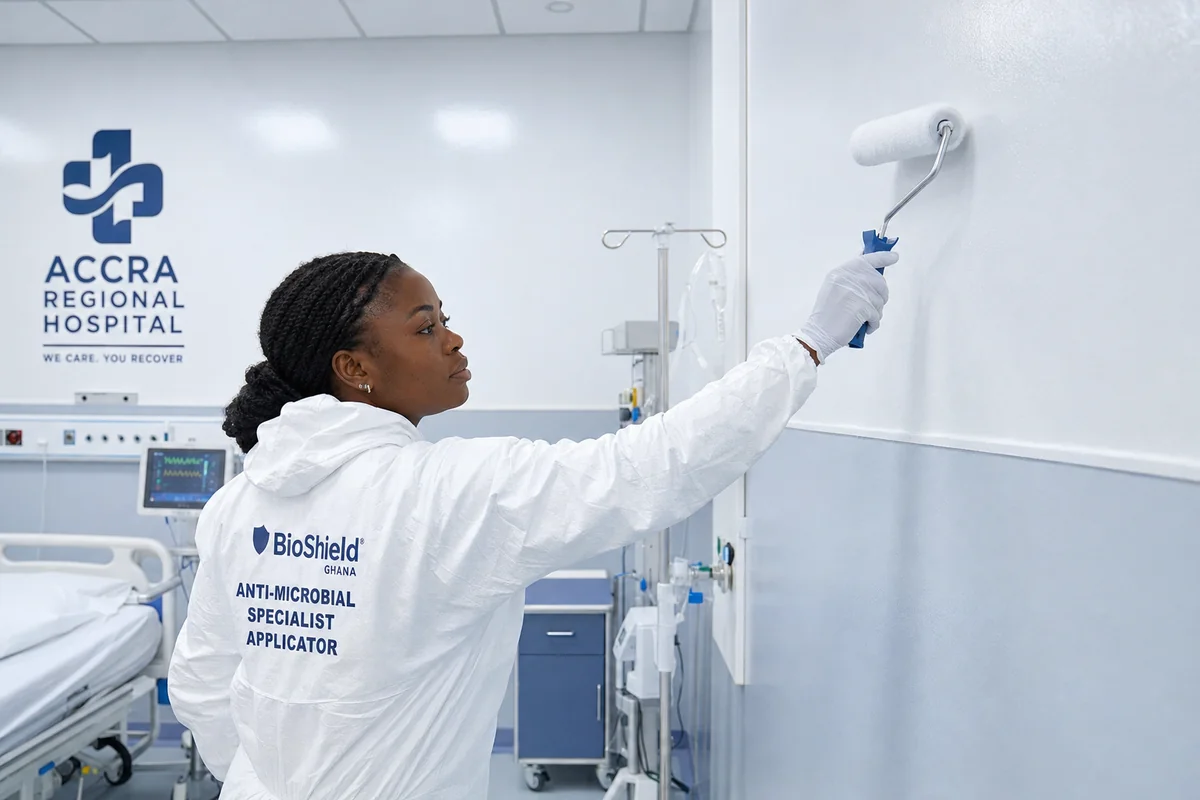
Silver-ion systems incorporate Ag+ biocides that release slowly from the cured film to disrupt microbial cells across the surface. As a biocide-releasing chemistry, the film keeps working between cleaning cycles, which suits wards, treatment rooms, and clinical wet areas where continuous protection matters.
Quaternary-Ammonium (QAC) Contact-Active Systems
Quaternary-ammonium systems bond biocides into the film so microbes are killed on contact, without leaching into the environment. As a contact-active chemistry it is favoured where surfaces are wiped hard and often and where a non-releasing system is preferred — food processing, preparation areas, and high-touch institutional surfaces.
Anti-Adhesive Hygienic Systems
Anti-adhesive systems give a smooth, low-energy surface that resists the initial attachment of microbes and soil, making cleaning faster and more complete. They are specified for cleanrooms, pharma, and laboratory interiors where a seamless wipe-clean envelope is the requirement.
Applications Across Ghana
- Healthcare wall and ceiling systems — wards, treatment rooms, corridors, and clinical wet areas requiring seamless cleanable surfaces
- Food-processing, handling, and preparation environments requiring wipe-down, growth-resistant finishes
- Cleanroom and pharmaceutical interiors where surface hygiene and chemical resistance are both specified
- High-touch institutional surfaces — reception zones, washrooms, and shared circulation in occupied buildings across Accra, Tema, and Spintex
How We Deliver an Anti-Microbial Coating
- Survey & hygiene-class spec — a free survey grades the substrate to ISO 8501 and matches the chemistry (silver-ion, QAC, or anti-adhesive) to the hygiene class.
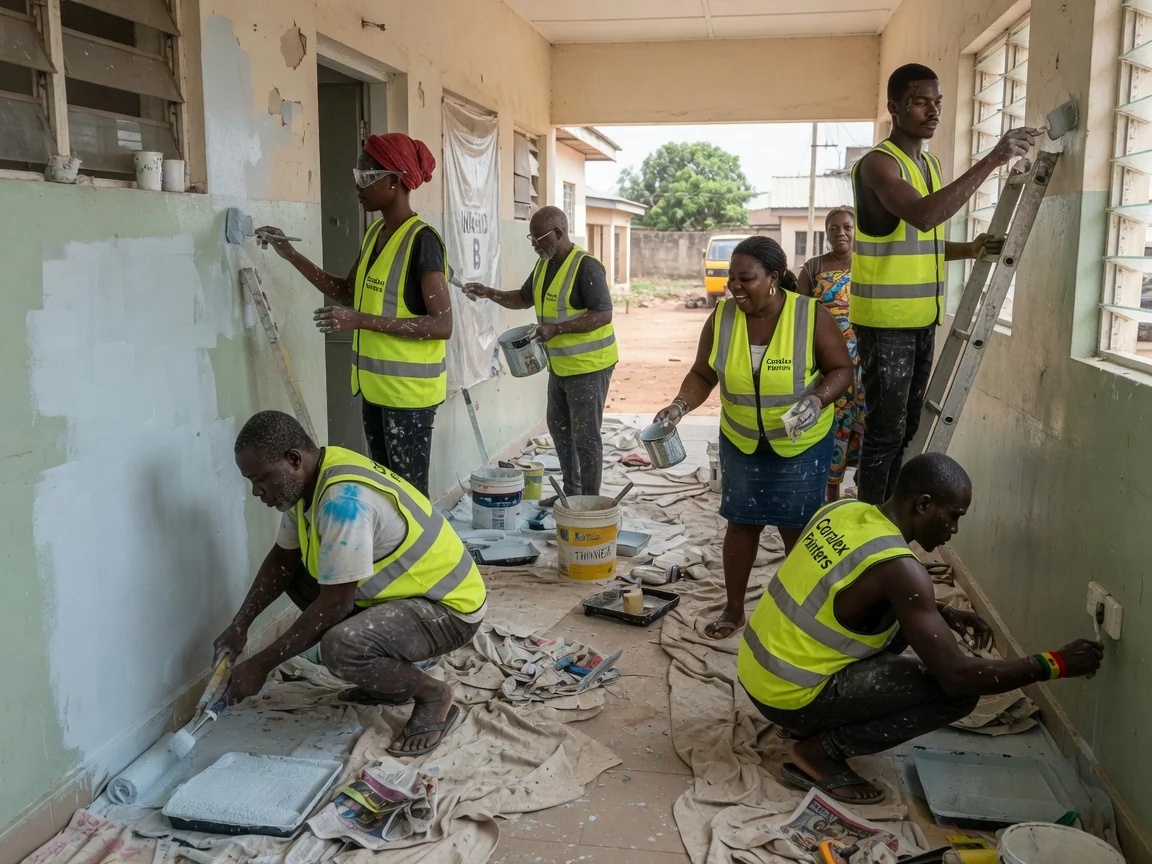
- Substrate preparation — chalk, biological growth, and failed coating are removed so the system bonds to a sound surface.
- System application — the hygienic system is built to a seamless, non-porous, cleanable film with no harbour points.
- Film-build verification & handover — dry-film thickness verified to ISO 2808, efficacy referenced to ISO 22196, signed off in writing.
Comparing Anti-Microbial Chemistries
| Chemistry | How it works | Class | Best for |
|---|---|---|---|
| Silver-ion (Ag+) | Slow-release biocide from the cured film | Biocide-releasing | Wards, treatment rooms, clinical wet areas |
| Quaternary-ammonium (QAC) | Bonded biocide, kills on contact, no leaching | Contact-active | Food processing, high-touch surfaces |
| Anti-adhesive | Low-energy surface resists attachment & soil | Anti-adhesive | Cleanrooms, pharma, laboratories |
Antibacterial activity is referenced to ISO 22196:2011 — a 24-hour test against Staphylococcus aureus and Escherichia coli, reported as a log-reduction value R, derived from JIS Z 2801.
What Affects the Cost in Accra
- The chemistry specified (silver-ion, quaternary-ammonium, or anti-adhesive)
- The hygiene class of the space and the disinfectant regime it must survive
- Substrate condition and the cleaning, crack remediation, or biofilm removal required
- Area (m²), ceiling height, and access in occupied premises
- The number of coats and total dry-film thickness the specification calls for
Every quote follows a free on-site survey — no fixed price is given before the space is surveyed.
Areas We Serve
Coralex Painters delivers anti-microbial coatings across Greater Accra — East Legon, Airport Residential, Cantonments, Labone, Roman Ridge, Dzorwulu, Spintex, Osu, and Tema — plus Kumasi and Takoradi.
Related Services
- Institutional Painting — durable, washable finishes for schools, hospitals, and government
- Industrial Coatings — ISO 12944 anti-corrosion and chemical-resistant systems
- Waterproofing & Protective Coatings — roof, terrace, and wet-area systems
Frequently Asked Questions
What is the difference between silver-ion and quaternary-ammonium anti-microbial coatings? Silver-ion (Ag+) systems are biocide-releasing — the film slowly releases silver ions that disrupt microbial cells. Quaternary-ammonium (QAC) systems are contact-active — bonded biocides kill microbes that touch the surface without leaching. We specify the chemistry to the hygiene class, the cleaning regime, and whether release or contact action suits the room.
What does ISO 22196 actually measure? ISO 22196:2011 measures the antibacterial activity of treated non-porous surfaces. A bacterial inoculum (typically Staphylococcus aureus and Escherichia coli) is held against the surface for 24 hours, and the result is expressed as a log-reduction value R versus an untreated control. It is derived from the earlier Japanese standard JIS Z 2801.
Where are anti-microbial coatings worth specifying in Ghana? In healthcare, food processing, cleanrooms, and pharmaceutical environments, where contamination carries the highest consequence and surfaces are cleaned hard and often. Ghana’s sustained humidity above 80% drives mould and biofilm on untreated walls between cleaning cycles, which makes a specified hygienic system worthwhile in any high-stakes interior.
How much does an anti-microbial coating cost in Accra? Cost is quoted per square metre after a free on-site survey, because it varies with the chemistry specified, the hygiene class, the substrate condition, the area, and the disinfectant resistance required. We never give a fixed price before surveying the space.