
The problem
On a commercial repaint, every fault is hidden by the coat that follows it — so a building can pass a final visual inspection and still be failing underneath, with no way to prove otherwise.
Our approach
Multi-Stage Quality Control for Commercial Painting
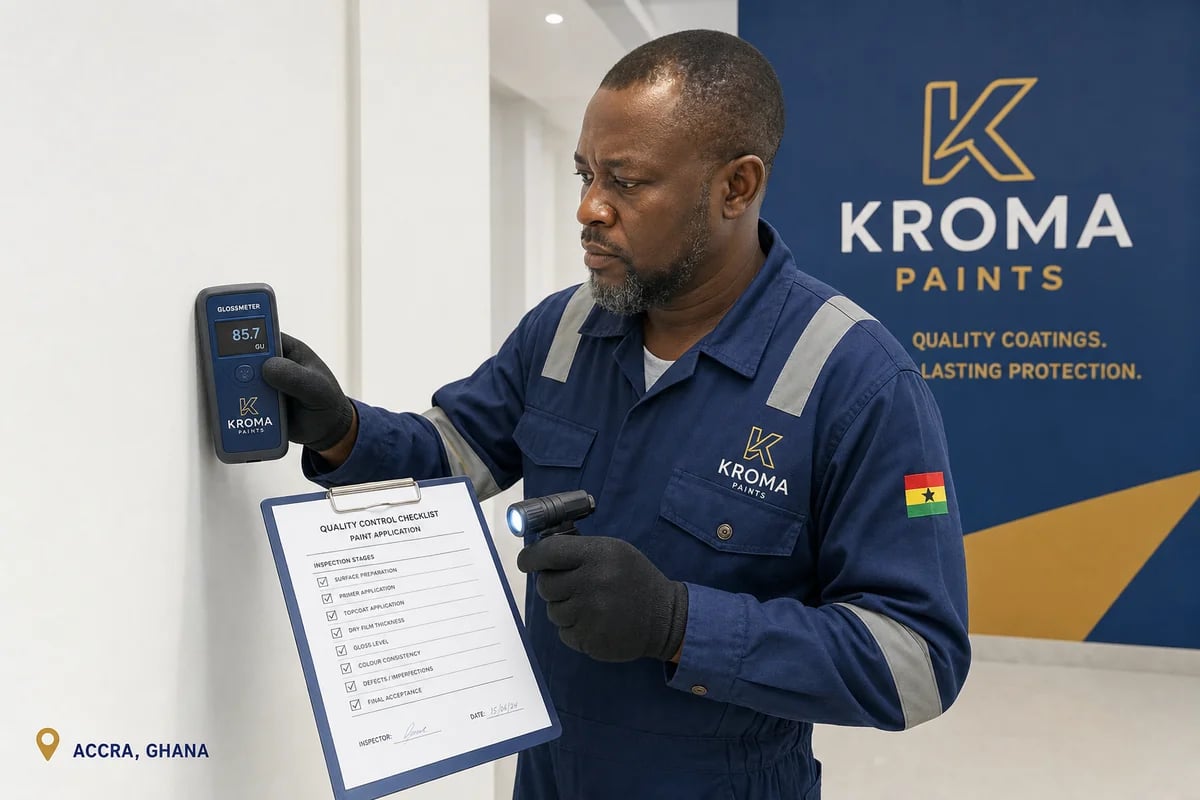
Multi-stage quality control for commercial painting by Coralex Painters — preparation, base, and finish inspected and signed off as the work proceeds, so defects are caught before they are buried and the building is proven, not just presented.
The Challenge
Painting is the trade most easily faked, because every stage hides the one before it. A wall left contaminated or under-prepared looks identical to a properly prepared one once the primer goes on; a primer skipped or thinned disappears under the topcoat; a topcoat applied below its specified thickness looks complete to the eye. By the time a client walks a finished commercial building, the only thing they can inspect is the final surface — and the final surface tells them almost nothing about whether the system beneath it will last.
That is why a single end-of-job inspection is not quality control; it is a hope. The defects that cause early failure — adhesion loss from poor preparation, premature breakdown from under-build, contamination sealed in under a good-looking finish — are all invisible by the time the building is presented. For a commercial client signing off a significant spend, the absence of staged evidence means accepting the result on trust and discovering the truth only when the coating fails.
The Coralex Painters Solution
Coralex Painters builds quality control into the sequence of the work rather than bolting an inspection onto the end of it. Each surface is checked and signed off at the stages where a fault can still be seen and corrected: after preparation, before any coating is applied; after the base or primer coat; and at finish. Preparation is graded against ISO 8501, so the substrate is held to a defined visual standard rather than a subjective judgement, and contamination or failed material is removed before it can be sealed in.
Through the build, dry-film thickness is verified to ISO 2808 — the specified protection only exists if the film is actually as thick as the system requires, and that is measured rather than assumed. Each stage is recorded as it passes, so a defect is caught at the point it occurs, when the cost to fix it is a corrected coat rather than a stripped wall. The client does not have to trust that the unseen layers were done right; the staged record shows they were. This is the QC discipline Coralex has applied to commercial commissions across Accra since 1972.
Documentation & Process Specification
Each commission carries a stage-by-stage QC record: preparation graded and signed to ISO 8501; base and primer coats inspected and recorded; dry-film thickness verified to ISO 2808 across the build; batch records for every system applied; and a finish inspection cross-referenced to the earlier stages. The result is a building whose hidden layers are documented, so the final surface is backed by proof of what is underneath it rather than presented in isolation.
Typical Engagement Profile
These engagements run on commercial commissions where the client or its project office requires verifiable quality — corporate buildings, banking halls, and public-facing commercial estates — whether as a standalone QC regime over a painting package or as the quality framework within a larger fit-out. They are evidence-driven and sign-off-bound, the kind of documented delivery Coralex Painters has run across Accra’s commercial market for four decades.
Outcomes
- Defects caught and corrected before they are buried under the next coat
- Hidden layers — preparation, primer, film build — proven, not assumed
- A staged QC record the client can rely on instead of trusting the surface
- A finish backed by documented evidence of the system beneath it