
The problem
Industrial floors and steel take chemical spills, forklift traffic, wash-down, and corrosion that ordinary paint cannot survive — so a decorative coating fails within months and stops the line to be redone.
Our approach
Performance Coatings for Industrial Environments
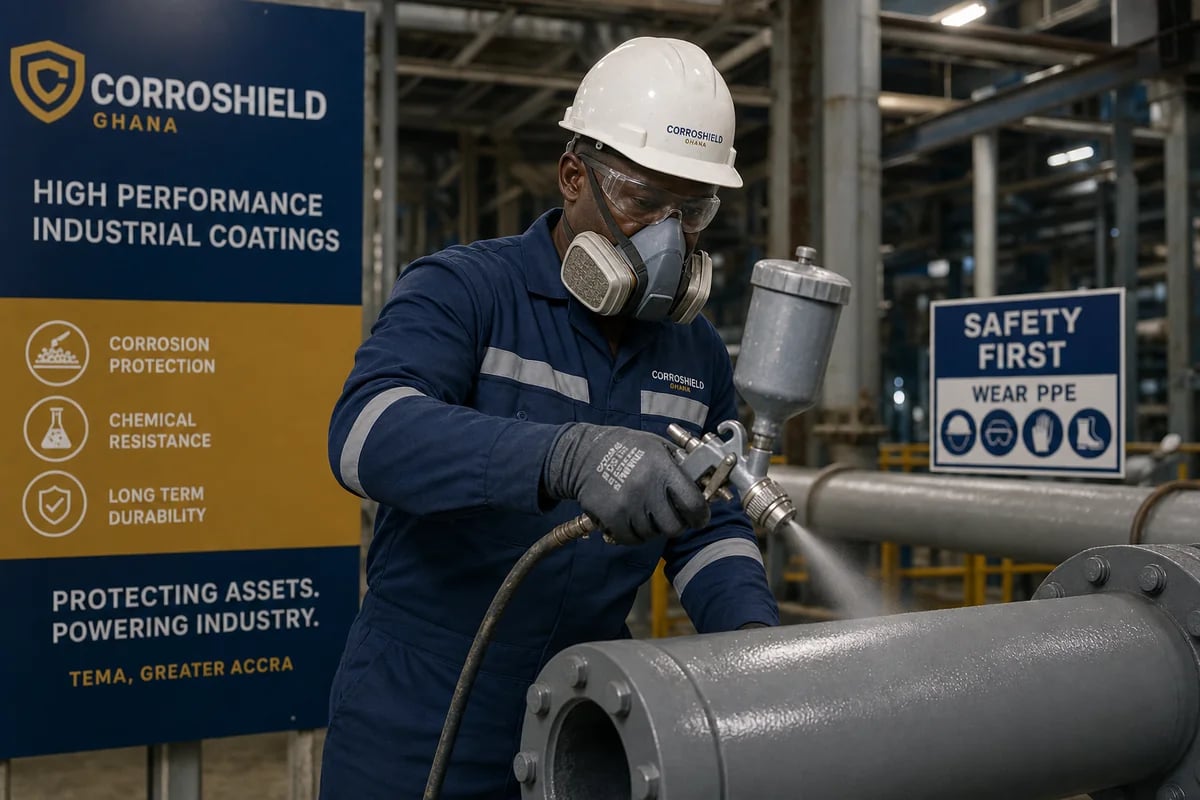
Performance coatings for industrial environments by Coralex Painters in Tema — chemical-resistant, abrasion-resistant, and anti-corrosion systems specified to the duty, applied to a verified film build, and documented through handover.
The Challenge
An industrial environment treats a coating as a wear part. A factory floor in Tema takes point loads from forklifts and pallet trucks, abrasion from constant traffic, chemical attack from process spills, and the repeated wetting of wash-down — often all in the same bay. Structural steel and plant in a humid, coastal-industrial setting corrode wherever the protective system is thin, damaged, or wrong for the exposure. A coating specified for an office wall does not belong in this environment, and when one is used anyway it fails fast.
The cost of that failure is not the repaint; it is the shutdown. A floor coating that delaminates under traffic, or a steel system that blisters and rusts through, forces an operation to stop the line, clear the area, and recoat — losing production to a problem that the right specification would have prevented. For an industrial operator, a coating is bought for the years of uninterrupted service it delivers, and the wrong one is bought twice.
The Coralex Painters Solution
Coralex Painters specifies industrial coatings to the duty the surface actually carries, not to a generic finish. The starting point is the exposure: the chemicals present, the traffic type and load, the wash-down regime, the corrosion environment, and the downtime window available to apply the system. From that, a matched specification is built — chemical- and abrasion-resistant epoxy or specialty floor systems for production areas, and anti-corrosion protective systems for steel and plant, selected against the corrosivity category framework of ISO 12944.
Preparation governs whether any of it lasts. Substrate preparation is graded to ISO 8501 — the surface profile and cleanliness a high-performance system needs is far beyond a wash and a sand, and the system is only as good as the surface under it. Through application, dry-film thickness is verified to ISO 2808, because an industrial coating delivers its rated chemical, abrasion, and corrosion resistance only at its specified build. Work is sequenced into the operator’s shutdown window so the system cures and returns to service on schedule. This is the protective-coatings discipline Coralex has brought to industrial work in Tema since 1972.
Documentation & Process Specification
Each industrial commission is delivered with a performance-grade evidence trail: an exposure and duty assessment; system specification referenced to the corrosivity category (ISO 12944) and the chemical, abrasion, and wash-down loads; substrate preparation graded to ISO 8501; dry-film thickness verified to ISO 2808 across the area; batch records for each system; and stage QC sign-off through preparation, base, and finish. The operator inherits a documented system they can maintain, extend, and reorder to match — not an unrecorded coat that has to be re-specified when it wears.
Typical Engagement Profile
These engagements run in working industrial settings across Tema — factory and warehouse floors, process areas, structural steel, and plant — sequenced into shutdown or low-activity windows and coordinated with the operator’s production and maintenance teams. They are duty-critical and downtime-bound, the kind of specification-led industrial delivery Coralex Painters has run across the Tema industrial belt for four decades.
Outcomes
- Coatings specified to the real chemical, abrasion, and corrosion duty
- Systems that hold through traffic and wash-down instead of failing in months
- Application sequenced into the shutdown window with a verified cure and return
- A documented system the operator can maintain, extend, and reorder