
Institutional Painting
Institutional painting in Accra, Ghana — durable, scrubbable, low-VOC waterborne finishes for schools, hospitals, banks, and government, with mould-resistant systems for humid wards and classrooms and work phased around occupied operations. Coralex Painters, since 1972.
Institutional painting is the specification-grade refurbishment of occupied public assets — schools, hospitals, banks, and government estates — to a durable, scrubbable, low-VOC standard, phased so the institution keeps running. Coralex Painters has specified and delivered institutional work across Accra, Tema, and Kumasi since 1972, treating the durable finish and the documented substrate engineering beneath it as one responsibility.
Why Institutional Painting Matters in Ghana’s Conditions
An institutional building is rarely empty. Schools run to term calendars, hospitals operate around the clock, banks and government offices maintain continuous public function. In these settings a coating is part of how the estate performs, not a cosmetic layer: it has to survive constant hand contact, frequent cleaning, and hospital-grade disinfectant without breaking down, while the work proceeds without disrupting the institution it serves.
Ghana’s climate adds a second test. Sustained humidity drives mould and biofilm in wards, classrooms, and sanitary areas, where an ordinary film blisters or grows between cleaning cycles. We answer with low-VOC waterborne acrylics that are scrubbable enough for repeated disinfection and, where humidity demands it, mould-resistant and breathable — specified to the function of each room rather than a single catalogue finish.
Institutional Systems We Offer in Accra
Scrubbable & Washable Waterborne Finishes
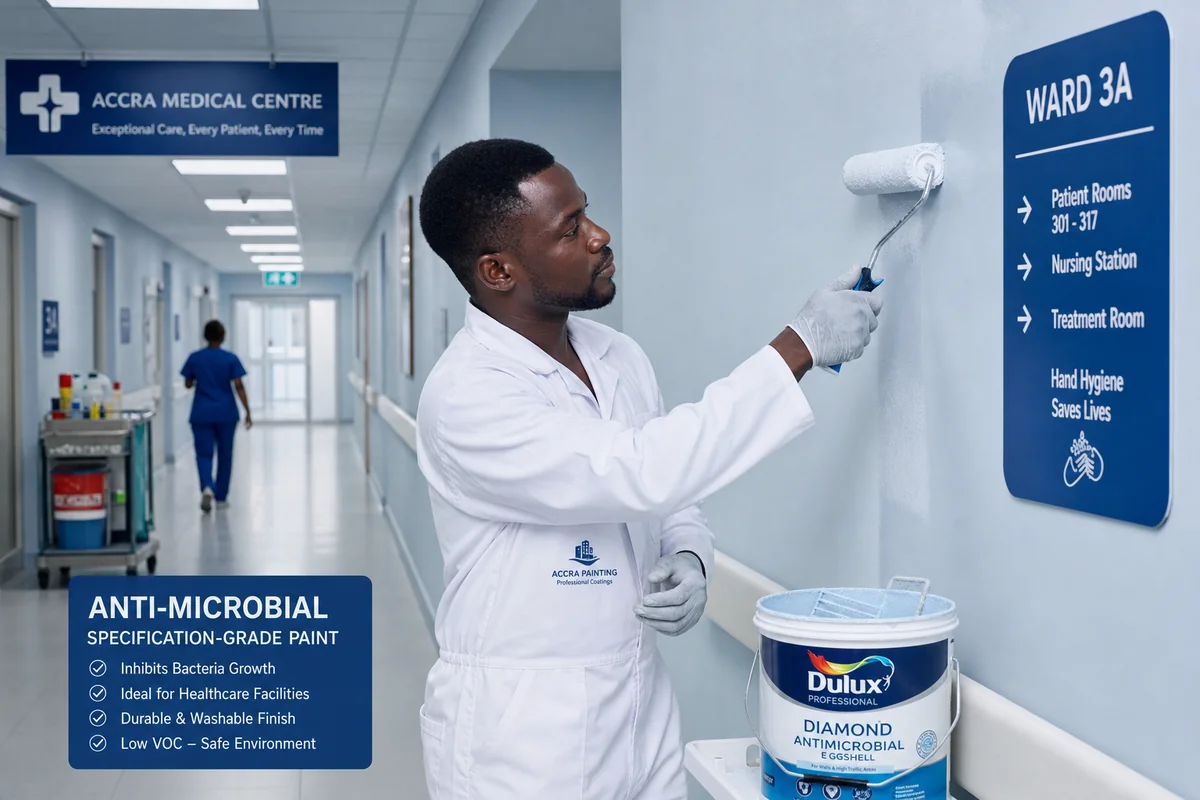
Low-VOC waterborne acrylics are specified for high-traffic corridors, stairwells, wards, and sanitary areas where surfaces are cleaned hard and often. We select systems rated to ASTM D2486 at 400 scrub cycles or more so the finish survives repeated wipe-down with hospital-grade disinfectant without burnishing or breaking down.
Mould-Resistant & Breathable Systems
In humid wards, classrooms, and wet areas, a breathable mould-resistant system lets the substrate release moisture while resisting biofilm growth, so the finish does not blister or stain between cleaning cycles. These are specified wherever Ghana’s humidity makes an ordinary film a liability.
Antimicrobial-Overlap Systems
Where a clinical, laboratory, or food-handling area requires it, institutional painting overlaps with anti-microbial systems whose antibacterial activity is referenced to ISO 22196 — a washable, durable surface that also resists bacterial and fungal growth.
Applications Across Ghana
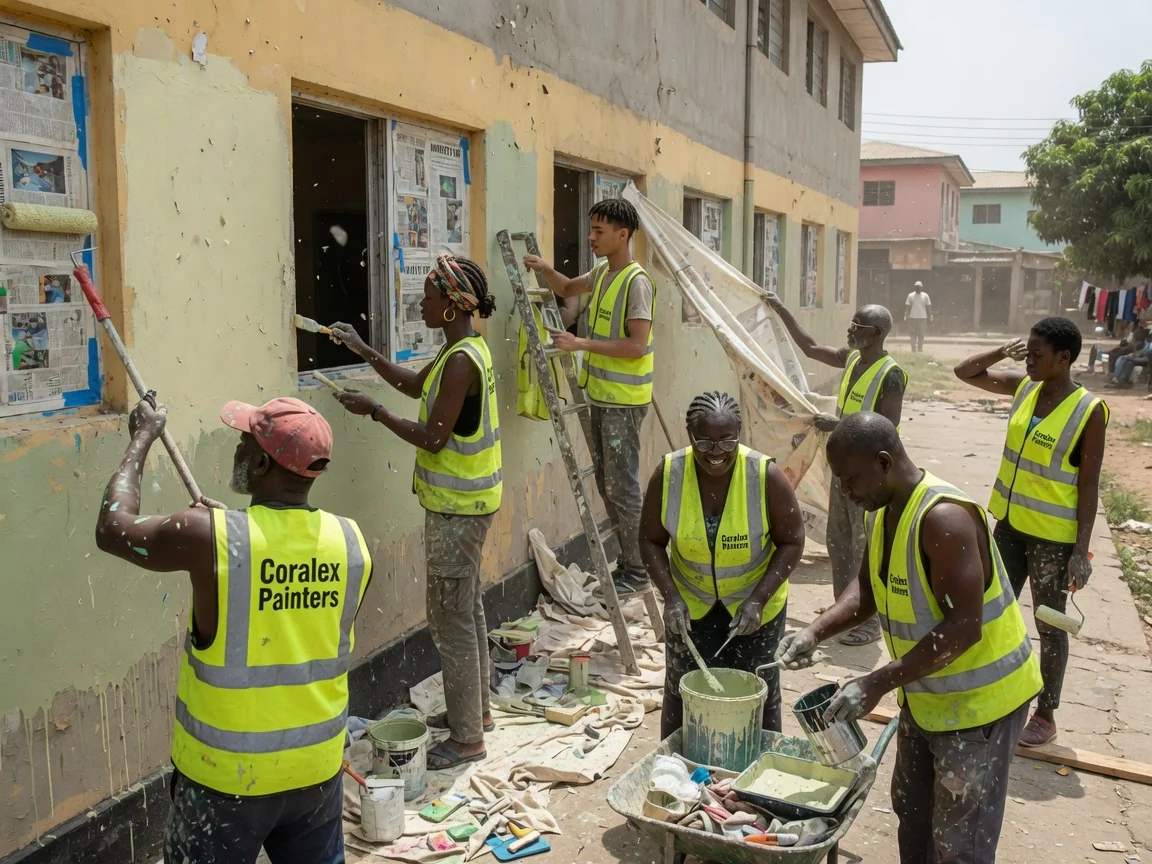
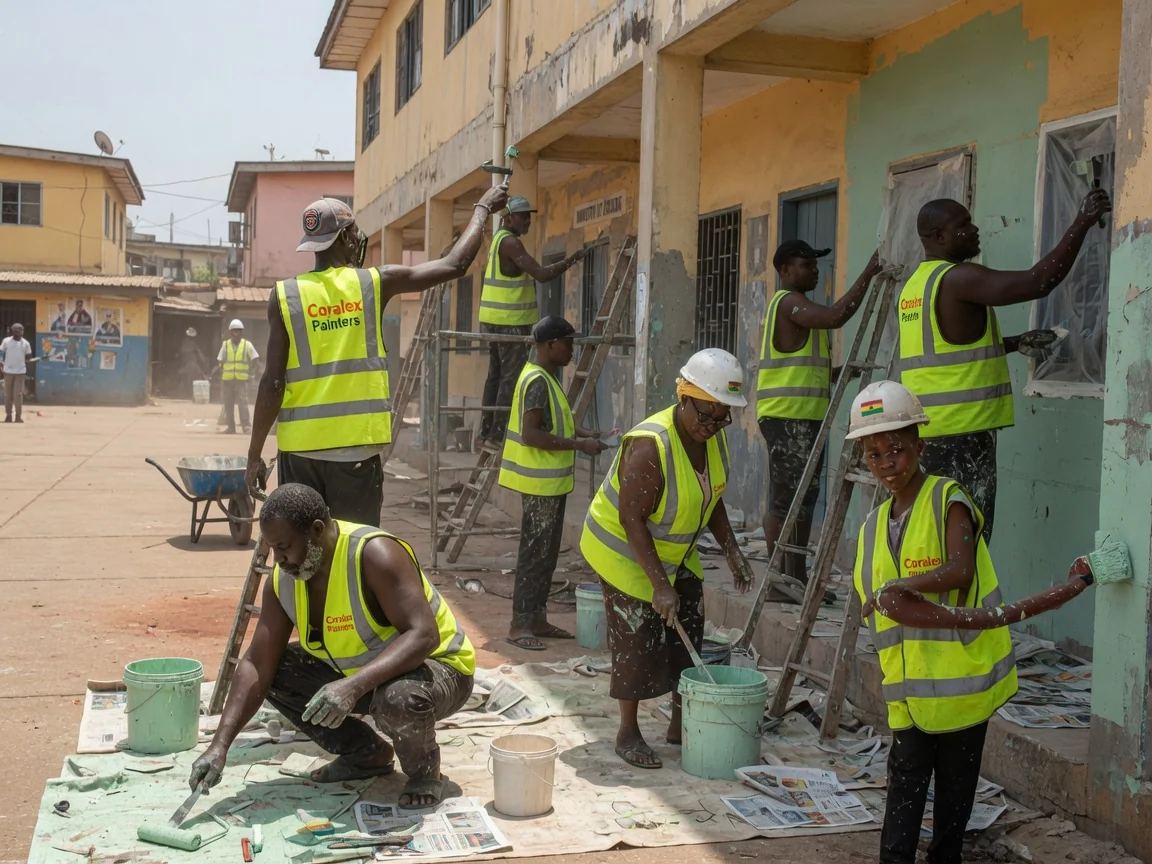
- Schools and university estates — classroom blocks, halls, libraries, residences, and high-traffic corridors
- Hospital and clinical environments — wards, corridors, treatment areas, and sanitary spaces requiring washable, mould-resistant, low-VOC finishes
- Banks and financial institutions requiring presentation-grade, durable public-facing finishes
- Government ministries and public administrative buildings under planned refurbishment across Accra, Tema, and Kumasi
How We Deliver Institutional Painting
- Survey & system spec — a free survey grades the substrate to ISO 8501 and specifies a low-VOC waterborne system to the function of each room.
- Substrate remediation — cracking, flaking, and failed coatings on the ageing estate are remediated before any new system is applied.
- Phased occupied-site application — applied ward by ward, block by block, or floor by floor, sequenced around operational schedules.
- Verification & written handover — adhesion confirmed to ASTM D3359, dry-film thickness verified to ISO 2808, each phase signed off in writing.
Comparing Institutional Systems
| System | Character | Best for | Where it is specified |
|---|---|---|---|
| Scrubbable waterborne acrylic | Low-VOC, ≥400 scrub cycles (ASTM D2486) | Corridors, wards, stairwells, sanitary areas | Hospitals, schools, banks |
| Mould-resistant breathable | Resists biofilm, releases moisture | Humid wards, classrooms, wet areas | High-humidity interiors |
| Antimicrobial overlap | Resists bacterial & fungal growth (ISO 22196) | Clinical, laboratory, food-handling areas | Hospitals, labs |
All institutional systems are low-VOC and waterborne — chosen for low odour in occupied premises, not for any Ghana legal VOC limit, which does not exist; Ghana’s binding paint regulation governs lead under GS 180:2022.
What Affects the Cost in Accra
- The system specified (scrubbable, mould-resistant, or antimicrobial-overlap)
- The substrate remediation the ageing estate requires before recoating
- Area (m²), ceiling height, and access across a large building or campus
- Occupied-site phasing and the operational constraints of clinical or term schedules
- The number of coats, finish grade, and documentation the procurement audit calls for
Every quote follows a free on-site survey — no fixed price is given before the estate is surveyed.
Areas We Serve
Coralex Painters delivers institutional painting across Greater Accra — East Legon, Airport Residential, Cantonments, Labone, Roman Ridge, Dzorwulu, Spintex, Osu, and Tema — plus Kumasi and Takoradi.
Related Services
- Anti-Microbial Coatings — ISO 22196 hygienic systems for clinical and food-handling areas
- Commercial Painting — brand-grade finishes for offices, retail, and hospitality
- Intumescent Fire Protection — passive fire protection for life-safety steel in occupied buildings
Frequently Asked Questions
What makes a paint suitable for hospitals and schools? It must be low-VOC and waterborne so the space can stay occupied during and after application, and it must be scrubbable enough to survive hospital-grade disinfectant — we specify systems rated to ASTM D2486 at 400 cycles or more. In humid wards and classrooms we add a mould-resistant, breathable system so the finish does not blister or grow biofilm between cleaning cycles.
Can you paint a hospital or school without closing it? Yes. Institutional work is phased around occupied operations — ward by ward, block by block, or floor by floor — sequenced to clinical, term, and operational schedules with low-VOC waterborne systems chosen so the space returns to use quickly. We hand each phase back in sequence rather than closing the institution down.
Do you offer antimicrobial finishes for clinical areas? Yes. Where a clinical or food-handling area requires it, we overlap institutional painting with anti-microbial systems whose antibacterial activity is referenced to ISO 22196, so the surface resists bacterial and fungal growth in addition to being washable and durable.
How much does institutional painting cost in Accra? Cost is quoted per square metre after a free on-site survey, because it varies with the system specified, the substrate remediation required, the area, the occupied-site phasing, and whether scrubbable or mould-resistant grades are needed. We never give a fixed price before surveying the estate.